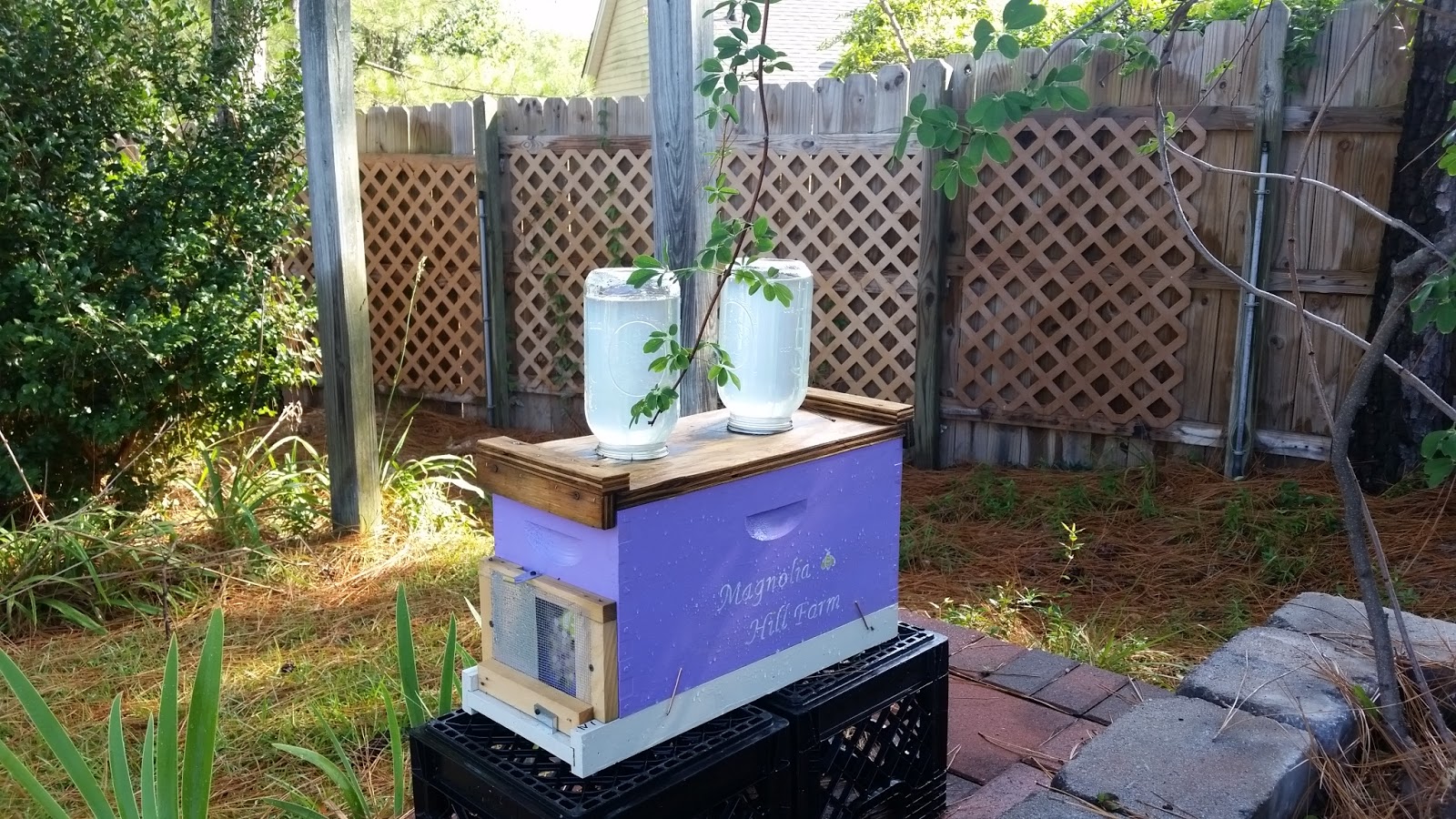
Last week, we installed a division feeder in my English hive. When I checked the hive yesterday, the feeder was empty. Some must have evaporated as the ladders don't quite reach the bottom, but the bees drank a gallon of nectar. It was easy to remove the cap and ladder to check and refill the feeder. (The cap and ladder we have is a wooden block with ladders similar to the ones in the link, but I'm not sure where hubby bought them.) We like the idea of feeding just our bees and this seems to work better than the bucket feeders on top of frames. There were no drownings, and that's always a good thing. It would be interesting to know how long it takes a hive to drink a gallon, but I don't want to disturb the hive too often to check. Regardless, we were putting out 5 gallons of syrup every two days and feeding every bee in the neighborhood with the exterior feeders.
It's hard to tell how much nectar the bees pulled from the feeder and how much they are finding on their own as there are clear signs that we are exiting the summer dearth, but the bees sure did fill a lot of frames in just one week. It doesn't seem to be enough yet to inspire growth -- there are still new larvae present, but not in great numbers. There was a lot of capped brood in our one large hive -- they are ramping up and producing some drones again, but nothing like we saw in spring.
Hubby is out inspecting our other big hive right now, but I am staying indoors and nursing my mixture of ant bites, mosquito bites, and bee stings from this week! An oatmeal bath followed by application of lavender essential oil finally stopped the itching. The fire ant bites are the worst, but the fire ants are also the easiest to deal with! After an application of Amdro, there are no more fire ants in front of the English hive, so neither the dog nor I need to worry about watching the bees go about their day. It may be a good thing that the dog no longer wants to sit in front of the hive -- if it prevents her from getting stung again, I'll suck up the bites on my feet.
The two big hives are jam-packed, so we made some splits this morning. We already had some bees in the queen castle, but they never managed to produce a queen that we could find. There was some uncapped brood in there, but no young brood. We moved the frames with resources over to a nuc and added some brood from the other hive and then created one more nuc. We'll move those nucs out to the out-yards one evening this week and hopefully get new queens soon.
It's hard to be so far from the farm for so long and not know what the bees, trees, grass, and flowers are up to in our absence. Those bees were pulling in nectar from the woods three weeks ago, and we left them with room to grow. It will be exciting to see what they are up to!
Sunday, August 28, 2016

Tuesday, August 9, 2016
Meet Maggie
 |
| Maggie - August 4, 2016 |
We adopted Maggie from the Coweta County Animal Shelter. We went there to look at a different dog, but Maggie was just so sweet, she won us over very quickly. We couldn't bring her home for a week
Maggie is a Catahoula mix and has already shown hunting instincts and/or training. One characteristic of Catahoula's is that they stalk silently and only bay once they have treed their prey. It was two days before we heard Maggie bark, but she has since alerted us to things that she thinks are noteworthy! Oddly, she barks a lot when hubby comes home from work. We think the
Maggie got a clean bill of health at our vet yesterday and behaved very well during our two hour visit there. In fact, she was less irritable than I was! Between my doctor's visit and hers, I spent far
On Friday, my plan was that Maggie would not be a couch potato, but by the time I got up at 6:50 a.m.
 |
| Maggie helps fold laundry. |
Monday, July 25, 2016
Secure storage
 | |
| Shipping container delivery |
We looked at metal and wood storage buildings. One big enough to double as a work-space and storage area would cost at least $6,000 and they all have windows, which makes them fairly easy to break in to. We went round and round for months, and finally settled on getting a shipping container. It is cost-effective and secure.
The next step was finding a company from which to purchase one. BIL bought one in spring and had to deal with missed delivery dates and an eventual delivery that was four hours late. We were prepared for a big hassle. If we had known how easy it could be, we may have bought one sooner!
We went to Jenco Sales, Inc. in Newnan, Georgia and received great service, a great price, and a delivery man who apologized for being five minutes late. I was a little hesitant when we arrived at the sales office because it looked different to what I expected, but that all changed the minute we were greeted and shown the different sizes and conditions of containers for sale. (Hubby thinks I'm crazy for expecting a car dealership type setup!) The staff could not have been more helpful and friendly. We had to cancel our first delivery date due to weather, and the company took that in stride. Hubby talked with office staff and the owner as we worked around predicted thunderstorms, and everyone was wonderful.
We don't have much in there right now, but we like knowing that it would take a whole lot of effort and heavy equipment for someone to take our garden rakes and shovels! We especially like knowing that the rakes and shovels will be in the same city as we are next time I want to plant a daylily!
"A rose by any other name would smell as sweet" William Shakespeare
 |
| Hummingbird |

The bees in the city and at the farm continue their feeding frenzy on the buckets and manage to drink 5 gallons of sugar water a day. It's amazing to see; I equate it to scenes of mall doors opening on Black Friday. A year ago I would have found it terrifying to watch, but now I know they are more interested in food than in me and the biggest danger comes from standing in the flight path of a highly focused bee! The bees are also bringing back more pollen than a couple of weeks ago and the queens are laying eggs again in both locations. The first Goldenrod flowers opened at the farm over the weekend, so the bees will soon have plenty of natural food. I haven't seen any Goldenrod around here yet, but it can't be far behind.
Why do we feed bees? Well, they would normally just stop reproducing at times like this when resources are scarce, and we are trying to increase our bee numbers before the final strong pollen and nectar flow occurs in fall. We were able to move two hives from 5 frame Nucs to 10 frame hives on Saturday, and did the same to two growing hives at one of our outyards one (very hot) day last week. If we can move into this time that resources are available with newly founded hives, they will have time to store supplies to get them through most of the winter. They more they can store, the less we have to feed them over winter, and the more food they have in December, the faster our bee numbers will grow in spring. Our focus so far has been in growing the number of bees. In spring, we'll focus on bee growth in some locations and honey in others.
 | ||||||
| Bees drinking on flat hummingbird feeder. |
Monday, July 18, 2016
Lavender and figs
 | |
| Fig jam |
 |
| Nuc with lid feeders and robbing screen |
 | |
| Planted cuttings |
In addition, we planted four gardenia cuttings, five butterfly bush cuttings, and seven Goldenraintrees. Our Goldenraintree at home is close to blooming, and it is a rich nectar source for bees, which is why we want plenty at the farm even though they can be invasive in the South. (Seed germination rates are lower in cooler regions.)
This afternoon we need to go pick up some woodware (hive bodies etc.) we purchased from a retired beekeeper and then go to both outyards to refill feeders, add a super to one hive, and check on a queen in another hive. We'd marked one hive as a deadout when we were trying to finish inspections right before dark one evening, but found a handful of bees and a queen still alive in the robbed-out and wax-moth infested mess the next day. We pulled some brood and nectar from our strongest hive in that yard to help get that hive going again, but the queen flew off in the transfer. (I actually caught her in my hands, but then she flew off again when I opened my hands to see what I'd caught.) We hope she made her way back home and is enjoying the top feeder. With hives in four locations, we really needed a better way of tracking inspections and our apiary to-do list. We tried a few apps, and Hivetool Mobile is working well for us as data syncs across devices, so hubby and I both have access to records. Inspections go a lot quicker when one of us checks frames and the other updates Hivetool. Hivetool also allows us to move a hive from one location to another while retaining history. Apiary Book is another good app, but data is limited to one device -- it would work very well for an apiary in which only one person is entering data. In between everything else, I need to number hive bottom boards to make tracking new hives easier as we assemble them. Our quick growth has led to us being less organized about things like that than we would like, so we're eating that elephant on bite at a time! Of course I've added a second elephant and am trying to write an apiary centered inventory program using Visual Basic in my spare time!
I've joked about needing to go back to work so that I don't have to work so hard, but I'm loving every minute of it. On the other hand, my students did very well on the IB exam and I am excited about teaching a new crew in a few weeks. Concentrating on non-education activities this summer has revived my love of teaching, and we'll start heading into a quieter garden and hive time soon. Our home-on-wheels is set up for relaxing get-aways throughout the school year. Life is good!
Wednesday, July 13, 2016
Just jamming...
 |
| Figs - July 2016 |
The first batch of jam I made used 3 pounds of figs and one pound of blueberries, and I like that I can still taste the figs. In one of the batches I made last year, the blueberries overpowered the figs. It was still good jam, but I prefer this batch.
The second batch used one pound of figs and one pound of strawberries. I also used one cup of honey and one cup of sugar instead of two cups of sugar. The fig/strawberry mix is good and there is just a hint of honey flavor. We both really like this recipe, but strawberry jam doesn't set as easily, and I'd like the next batch to be a little firmer. I used some pectin, but clearly not enough!
Today I used the same Drunken Fig Jam recipe that everyone liked so much last year, but I substituted honey for half the sugar. We couldn't taste the honey at all, so I will just use sugar next time. It makes more sense to keep honey in the pantry than to hide it in jam. I'll make some more batches of the original recipe, but then I plan to experiment using Stevia for a lower calorie version.
Between checking hives, feeding bees, and making jam, I have no time to get bored at all. Summer is flying by, and we have to stop to consciously look at what we have accomplished rather than focusing on what we have not yet even started.
Monday, July 11, 2016
Living on our land.
 |
| RV moved onto our land. |
 |
| Checking the English hive |
We had opened the English hive shortly after our new queen had hatched. It was clear that she had dispatched most of her sisters, but there were two queen cells intact that we had hoped we got to before she did. No dice. The two-frame section of the queen castle in which we installed the cells with a couple of frames of bees from another hive contained only a few dead bees, some hive beetles, and wax moth trails. We were disappointed and took the frames over to the shed so that we could put them in the freezer as soon as we took the suits off. Hubby put the smoker and hive tool up, took off his jacket, turned around to pick up the frames, and, lo-and-behold, there was a brand new queen searching the frames. Of course, all the queen isolation stuff was in the garage, but we did manage to get her into a queen cage and installed into the castle with a couple of frames of bees, larvae, and honey. We're pretty sure we have a drone congreation area in our yard as we have found an abnormal number of queens and I've even had mating bees clinging to my tshirt!
 |
| Figs, July 11, 2016 |
Subscribe to:
Posts (Atom)