Visit us at http://lazercreekapiary.wordpress.com/
If you like our blog, please click the follow button on the new page. Thanks!
Friday, June 2, 2017

Saturday, May 27, 2017
Bee Rescue
 |
| First stage of bee removal done. |
Why two sections of plywood, you may ask! Well, we're not the first to pull bees out from this floor. The bees were getting into the soffit by crawling up the mortar joints between the brick siding and then crawling through that big gap between the joists. The previous beekeeper sprayed foam insulation into the gap to keep the bees out, but the bees ate it! I guess once wood smells like wax, propolis, and brood, bees will eat just about anything to get back home.
 |
| Broken comb sections from first section |
Once we had the bees and the mess they'd made out (it's not a mess in a hive, but I wouldn't want honey dripping onto my sheet-rock dining room ceiling), we secured the gaps with window screen. We then went outside, removed the fascia, and blocked the entrances from that direction. By that time, we could remove our suits in the room (it's a toasty 90 degrees today), and continue clean up. Hubby secured a piece of plywood over the window screen and also added some vertical blocking, just in case. The bees had been exploring and ending up in the kitchen light fixture on the other side of the house before we were called in, so if they find another way in, we want them to be confined to a small area.
As there's no way for us to eliminate the home-sweet-hive smell from the joists, hubby filled the cavity with insulation and now has the floor put back together. I came home and got the bees situated in their temporary homes, and the day was a success!
 |
| Beautiful comb honey |
It's been a rewarding, exciting, nerve-wracking, satisfying start to the holiday weekend. We'll go back over to the house tomorrow and Monday just to make sure everything is okay and the foragers realize that their family moved and didn't leave a forwarding address!
All-in-all, I don't regret staying in the city to do this. I'll head down to the farm next weekend and see what the bees down there are up to. I'll have to come back to the city periodically as the fig tree has gone insane, but more about that later!
Sunday, April 23, 2017
Relaxing at the creek
 |
| Relaxing at the creek |
Once we got down the the creek, we didn't want to leave. Just like when we were children, we became enthralled with watching the eddies as they swirled around the rock. We laughed when Maggie stuck her head under the water and blew bubbles out of her nose as she tried (and succeeded) to get a rock. We watched bees and butterflies land in the sandy bank to get water and minerals. We sat and dreamed about the future and the live we will life in this beautiful place we own.
 |
| Cooling our feet in the creek |
We returned home to find healthy, humming, hives with lots of nectar. The hive with the second swarm we caught this spring had two queens in it, so we had an extra to put into one of the new splits that had an open queen cell, but no queen. The other split has a queen, but we didn't see any larva on Monday. It's supposed to storm this afternoon, so we'll probably check again tomorrow after work.
 |
| Jumping the creek |
So now Maggie gets to sit on the couch and watch me grade another batch of essays. IB and AP exams start in just over a week, so this is my second-to-last batch of the year other than optional revisions that students will turn in over the next couple of weeks. I see both daylight at the end of the tunnel and the fruits of my labors as some of my weakest students are now writing good, analytical essays. Just like raking clay back into a 600 foot long trench becomes tedious after the first hour or so, it, and these final essays, leave me feeling that every bit of effort I put in is well worth it.
Tuesday, April 11, 2017
Water for the orchard
 |
| Trench for irrigation |
We needed some parts that weren't available at Foster-Taylor, so we made two trips to Lowe's. Our new Lowe's is the one in Griffin, Georgia. Shopping there was such a pleasure today -- great atmosphere, friendly and helpful staff, organized displays -- I just wandered around looking at stuff while waiting for hubby to find all the right widgets and I felt totally relaxed. Our trip to the other Lowe's was the exact opposite, which is enough said about that!
I planted more cleome, sunflowers, poppies, and phlox for us and the bees to enjoy. I get my cleome and bee tattoo next week, so that should tell you how much I like those particular flowers. I also weed-eated to clear space around the red cedars I planted a couple of months ago and to clear the area around our memory bench.
We have one hive left to check, but all the others are doing great. Well, one is looking a little iffy, but the rest are fantastic! The iffy one has (had) and old queen that is no longer laying as much as she should be. I still struggle with the concept of killing a failing queen, so we put her in a NUC to live out her life and made sure the other hive still had plenty of young brood with which to create a new queen. It's a compromise that I hope will go well. The big hive we brought from the city has a fat and active queen now and the bees are no longer bad-tempered. Hopefully hive 47 will go the same way.
I'm sitting in the sun blogging at the end of a very busy day and wondering why I have so much more energy here. Is it the vitamin D or just the peace and quiet? I think I need to sit outside during lunch at work to see if I can avoid the 3:00 p.m. slump that I get in the city. It's good to come to the farm and figure out that it's not old age that makes us both want to fall asleep right after supper. Hmmmm -- maybe the absence of a TV is helping us stay awake! After all, how many times can we watch the same epidsodes of "Last Man Standing?" Here's hoping I figure it out while sitting here waiting for the sun to set and the moon to rise.
Saturday, April 8, 2017
Happy People: Happy Bees
Last night, as we were deciding which trees were ready to fend for themselves at the farm, hubby spotted another swarm of bees in our yard. Once again, they were behind the trealis and a fence post. The poor honeysuckle is still recovering from the last swarm extraction, and this time the two grapevines got to share the pain! (I should know in a couple of weeks whether or not grapevines can be rooted from "cuttings"!)
These bees were quite cooperative. Hubby scooped a couple of handfuls into a NUC, I squirted some Honey B Healthy onto the inner cover, we gave them a stick to use as a bridge and they pagenented right on in. By the time we'd checked the other hives, only two lost bees were still wandering around on the fence.
One of our other splits now has the fattest queen I have ever seen, so that NUC made the trip to the farm and the bees are already bringing in loads of white pollen. We moved them up to an 8-frame so that they could get over all of their confusion about the new location at once and they seem to be as happy as clams. The queen cells in the sister NUC have hatched, but we didn't see a queen. Hopefully she will find her way home in a couple of days.
The other hives at the farm are all active, but we didn't check them today. Hubby is digging more tenches for water lines and I planted some tomatoes and thyme. We are really curious to see whether the diatomaceous-earth we sprinkled on the ground two weeks ago has had any impact on the small hive beetles. It's supposed to kill them when they go back onto the ground to pupate. Now that the hives are stronger, we aren't seeing as much of a problem as when we came out of that really cold snap, but we'd love to see no beetles at all. It still seems like having the hive in a sunny spot works wonders, but that is going to make hive checks challenging in July.
The dog is chewing on a pine-cone, hubby is working hard, and I'm enjoying sitting out in the 72 degree sunshine. It's amazing to sit here at this time of day and see just how many insects are flying around at any given time and at how many spider webs are catching the sunlight. Even with the sound of the Ditch Witch, the farm is so peaceful and just a good place to be. We are just so very lucky and happy to be here.
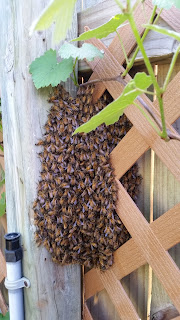 |
| Swarm - April 7 |
One of our other splits now has the fattest queen I have ever seen, so that NUC made the trip to the farm and the bees are already bringing in loads of white pollen. We moved them up to an 8-frame so that they could get over all of their confusion about the new location at once and they seem to be as happy as clams. The queen cells in the sister NUC have hatched, but we didn't see a queen. Hopefully she will find her way home in a couple of days.
The other hives at the farm are all active, but we didn't check them today. Hubby is digging more tenches for water lines and I planted some tomatoes and thyme. We are really curious to see whether the diatomaceous-earth we sprinkled on the ground two weeks ago has had any impact on the small hive beetles. It's supposed to kill them when they go back onto the ground to pupate. Now that the hives are stronger, we aren't seeing as much of a problem as when we came out of that really cold snap, but we'd love to see no beetles at all. It still seems like having the hive in a sunny spot works wonders, but that is going to make hive checks challenging in July.
The dog is chewing on a pine-cone, hubby is working hard, and I'm enjoying sitting out in the 72 degree sunshine. It's amazing to sit here at this time of day and see just how many insects are flying around at any given time and at how many spider webs are catching the sunlight. Even with the sound of the Ditch Witch, the farm is so peaceful and just a good place to be. We are just so very lucky and happy to be here.
Sunday, March 19, 2017
Arbor Day aids my procratination
 |
| Trees and shrubs - protected from the dog with milk crates! |
So, I managed to put off grading for an hour or so while I played with plants, potted the blue-berry bush I bought yesterday, and started some trays of tomatoes and peppers. I honestly planned to get comfortable and grade after that, but when I took the trash out I found a box of trees from Arbor Day on the front step. We didn't receive our entire order, but there was enough planting to do for me to postpone grading another hour. Then I ate lunch. Now I'm blogging!
Yes, it's that time of the year when it's hard to stay indoors. It's neither too hot nor too cold outside. It seems that every day another variety of daffodil blooms in my garden. The bees are buzzing contentedly and the grumpy ones are 270 miles away at the farm! I do love teaching, but it's also the time of year when I am just tired of reading essays! Spring break is late this year, and most of our spring days-off became inclement weather make-up days for the third year in a row. Students are ready for spring break. Teachers are ready for spring break. We are knee-deep in state mandated standardized testing, and I just want to take the dog for a long walk.
But enough complaining. The trees and shrubs we received so far this year from Arbor Day have really good root systems, unlike some of what was shipped last year. The Catalpa and Red Maple trees are a good height and I actually had enough potting soil at home to plant them all. The arrival of this box is a reminder to grab another bag of potting soil next time we're at Lowe's, and my Lemon Grass and Mandevilla both survived winter in the greenhouse. The Mandevilla is even blooming already. The two varieties of Chocolate Vine on the arbor are filling the yard with a jasmine-like scent, and spring break is only three weeks away. As always, life is good.
Saturday, March 18, 2017
Spring is back - maybe?
 |
| Farm hive, March 2017 |
All of the hives at the farm have gained strength now that the bees are not spending all their time chasing beetles and there is a plethora of nectar available to them. We took one of our older hives from the city down there to see if the bees are any happier there. The hive has served us well and the old queen laid many eggs when food was available to the hive. The problem is, they have become increasingly mean. Inspecting them was no fun at all and once in a while one would "get a bee in its bonnet" (bad use of an idiom, I know) and chase us into the house. I don't know if they feel threatened by my long hair, but angry bees often became tangled up in it, which made both them and me more angry! We decided they could no longer live in the city. The hive replaced the queen a couple of weeks ago, so bees from the new queen could well be more friendly. If not, we'll replace her with a queen from one of our gentle hives. If hubby had had his way, the old queen would have been replaced in January, if not last fall. I am becoming more practical and believe I will eventually be able to see an aging queen as disposable, but I'm wasn't there in January. After being chased across the yard a few times over the last few weeks, I may be there now!
Our city hives came through the most recent cold snap well. Only a few were using the feeder buckets last weekend, but the buckets were crowded yesterday. Once it warms up, I'll put hive top feeders back on our new NUCs so that they can rebuild their stores. The first swarm capture was a little low on bees last weekend, and we had queenless and broodless bees in one of the queen castle sections. We combined them by stacking a second NUC body on top of the first and adding the lonely bees so that they could keep the beautiful new brood warm and have a queen to worship (or boss around.) The NUC with the bees from the second swarm capture had 3 full frames of bees last weekend and the queen was busy searching cells. There wasn't any capped brood last weekend, and I have a hard time seeing eggs with my bi-focals and the veil, but she's healthy and active so we expect to see something when we do our next check.
We also have three batches of bees in the queen castle that had hatched queen cells last weekend, but we didn't see the queens. It was a beautiful day, so they may have been out mating. I so much want to go look, but it's not warm enough yet.
Hubby will check the farm hives tomorrow, weather permitting. He's helping his brother with some projects today while I'm stuck here with a crate full of essays to grade! So much of what I planted in fall is coming up right now that I really want to go to the farm every weekend, but sometimes we just have to stay home and get chores done!
Friday, March 3, 2017
A Sweet Reward
 |
| Swarm |
Surprise number two was even better. I made my usual evening walk around the yard and said hello to all my bee-buddies. On the way back to the house, I noticed that the Major Wheeler Honeysuckle had new blooms on it. That thing hasn't stopped flowering all winter, but it is now adding buds like crazy -- or was before we chopped a whole lot of it off about an hour ago. While I was walking toward the fence to admire the flowers, I noticed something odd. That something odd turned out to be a swarm of bees.
 |
| Swarm in the lattice |
Swarms can be really good because they add genetic lines to the exiting apiary. They are also good simply because they make me happy! There were as many, if not more, bees behind the lattice as in front of it and almost all are now tucked away safe and warm in their new home. We have not yet found the queen, but the bees did start to pageant into the NUC after a while, which is normally a good sign. Temperatures are supposed to drop to the low 30s tonight, so we're glad we caught them when we did.
We bent the lattice back and cut many of the vines to get the bees out of there. Some that started flying around settled in another clump in the middle of the next sheet of lattice while others hid behind the fence post. We got what we could with a bee brush and smoke and then tried a bee-vac on the remaining couple of handfuls. We're still not sure about the bee-vac -- some bees got tangled up in the felt that they are supposed to bounce against and some appeared stunned, cold, or dead. While we hate to lose any bees, trying to get a handful out of a tight corner was a better experiment than trying to suck up a full swarm. We'll have to find some non-living things to test levels of air-flow with.
Still, a day full of annoyances turned out to be an incredibly wonderful day after all. This is the second swarm we have caught in two weeks -- one just moved into the queen castle while we weren't looking and started setting up house. Our bees at the farm were bouncing back after their fight with the hive beetles last weekend, and we'll soon have some more hives to take down there.
Wednesday, February 8, 2017
Spring is Here - sorta
We checked our city hives 10 days ago, and one queen is laying like crazy while the other one still appears to be on winter vacation! Both hives have lots of bee bread, so brood is imminent. So, is it that much cooler in the corner where the "lazy" queen is or is she just running out of eggs? We'll take a peek in the hives again on Sunday if it's warm enough.
I hate the idea of replacing a queen we have raised from an egg and who has served us so well for over two years, but it's a fact of life that we may have to dethrone her and find a replacement. We have three queen cells on frames in the queen castle, but we won't know if they are viable for a few weeks so the old queen still has time to prove she's worth her keep. She has been a fantastic queen -- lots of eggs and friendly bees. I'm hoping she starts filling up those frames by Sunday!
I checked my hive at the farm, and the bees have barely started making bee bread. It's odd, because some plants around the farm like Forsythia are ahead of the ones here, but other plants still look dead. Why can't spring give clear signals? It was a little too cool to go into the hives that were not in the full sun, so I guess we'll check those next trip.
Hubby bought pollen to try to jump-start the hives, but the bees don't seem to like it. At least, they don't like it at this minute! We know that bees want what they want when they want it and select the flowers that provide the micro-nutrients they need at any given time. They might want our pollen next week, or they'll crave something that's blooming.
After buying the pollen, we read about the downside of trying to create queens early in the season -- it doesn't matter how many queens we produce if there are no drones with whom they can mate. Bees kill drones when going into winter as their only job is to mate with queens. So, no drones, no fertile queen -- and the bees will kill a queen, or at least kick her out, if she doesn't start laying eggs as quickly they think appropriate. Our strongest hive had many drone cells 10 days ago, but are there enough from other hives for a successful mating flight?
As I've found out with seedlings over the decades, you can't rush nature. It helps to get a little jump-start with the greenhouse, but trying to move nature's time-table up by a month isn't in the cards. Once again it all comes down to patience, which I may learn eventually!
Sunday, January 22, 2017
Candy Boards - Feeding Bees
Candy boards are a great way to feed the bees in your hives without feeding all of the bees in the neighborhood. The above video from Brush Mountain uses cooked fondant, which is what we have been doing successfully for two years now -- we just poured the fondant into paper plates and placed those on top of the frames. We had pollen patties in the fridge, not pollen substitute in powder form, and experimented with putting pieces of that in with the fondant, but the bees never seemed interested in eating that. We were hesitant to leave the remaining pollen in the hive as pollen patties have a reputation for attracting small hive beetles. While we don't have much of a problem with SHB in the city, but we do in our out-yards. Some of the blogs I've read about them attracting SHB state that they simply provide another place for the critters to hide.
Fondant is all well and good when cooking for a small number of hives, but when I don't have time to cook for us, I certainly don't have time to cook for our winged friends. Hubby cut down some of the shallow hive bodies that we had and has started making candy boards as described in the video below.
The thing we like about this kind of candy board is, of course, not having to spend 30 minutes boiling syrup followed by another 30 minutes cleaning the kitchen. The wire bottom also allows more bees to feed at one time. We also know that every batch of fondant turns out differently -- see previous blogs -- and I've had one batch turn to rock while my back was turned and another batch turn into a gooey mess while sitting in the fridge. Softer fondants are easier for the bees to digest but are also hygroscopic -- hence the mess in the fridge. With the humidity we have here in the south, we are concerned about sticky goo damaging the wood and trapping bees if we use the method in the first video. We'll let you know how these wire-bottom boards work out.
We'll add some pollen to the candy board to get some brood started in our bee engines - our city hives. The bees in the city and out-yards bring pollen in throughout winter, but they may need a little more to start producing brood. With our crazy weather, it's hard to know when to do this. We don't want to start too early as brood gives the bees one more thing to keep warm when temperatures drop, but we don't want to wait too long either. We really want to build up our numbers this spring and maybe have some queens to sell to offset some of the costs of starting up our apiary. We're going to use a Nicot System to get some queen cells started and hopefully save some time on getting new Nucs started as well as adding a revenue stream.
It's still winter, but it feels like spring, and this is always a time of year that I find it almost impossible to be patient. The daffodils are pushing up in the city and even some day lilies are sprouting new leaves. It was below 20 degrees two weekends ago, over 70 degrees last weekend, and stormy this weekend. Planting seeds this early is usually pointless, but I'll probably do it anyway. I usually do. When the sun is shining like it is right now, I just want to hurry spring along and get those home-grown tomatoes started! I'll try, once again, to temper enthusiasm with some common sense and not bring more harm than help to the bees and trees in our care!
Sunday, December 25, 2016
Hubby learns the true value Of Patience
Hubby here:
Patience? We all use the word directed at others when we want them to slow or wait for something. We also like to describe ourselves as being patient. Me personally, I have now added the word "patience" to my project design and time analysis over the last year. I've also directly related patience to time. Over the last year as we have grown in our skills and knowledge on the farm I personally, and very humbly, have come to realize if you analyze your project or task and determine for example that putting up barbed wire fencing will only take about 1 1/2 to 2 days... triple that or even quadruple that time!! Then figure out if it will be 100 plus degrees during the day or will the infamous biting ladybugs drive you to distraction. And worst, when you feel your age, exhaustion and that durn picket post-pounder has mysteriously gained 40 pounds by the end of the day that maybe you really do need to add a few more days to the project. "Patience"... my new word for the day.
Patience? We all use the word directed at others when we want them to slow or wait for something. We also like to describe ourselves as being patient. Me personally, I have now added the word "patience" to my project design and time analysis over the last year. I've also directly related patience to time. Over the last year as we have grown in our skills and knowledge on the farm I personally, and very humbly, have come to realize if you analyze your project or task and determine for example that putting up barbed wire fencing will only take about 1 1/2 to 2 days... triple that or even quadruple that time!! Then figure out if it will be 100 plus degrees during the day or will the infamous biting ladybugs drive you to distraction. And worst, when you feel your age, exhaustion and that durn picket post-pounder has mysteriously gained 40 pounds by the end of the day that maybe you really do need to add a few more days to the project. "Patience"... my new word for the day.
Well house and other projects
 |
| One coat of stain |
 |
| Two coats of stain |
 |
| Finished Door |
We spent most of the rest of the morning gathering rocks from around the property to build up the area below the old clay culvert that runs under an old road bed built around the early 1900s. We cleared out some more brush around the area yesterday, and I planted some more daffodils and a weeping willow tree behind the bench. Even though the Stratford-upon-Avon council cut down the willow trees decades ago, I will always associate weeping willows with the banks of the River Avon. Although the willow is still shorter than I am, our memory-bench is already the perfect place to sit and think about family members. If the blue bells and daffodils flourish, it will almost be a little piece of England.
 |
| Clay culvert |
Some of the stacked stone around the culvert has crumbled away and there was a deep erosion hole below the culvert. In order to minimize additional damage, we've raised the level in the hole by about 2 feet and cleared the stream bed to facilitate drainage. Eventually we plan to have rock all the way to the small pool that naturally forms 90% of the year. I hear hubby throwing rocks in the cart now, but I don't plan on picking up even one more today. We pulled some moss up from another part of the property and packed that around some of the stones further down than this picture shows, and I transplanted some ferns along the edge of the dry-stream. We'll throw some wild-flower seeds out in spring and make the place as inviting to humans and bees as possible.
Talking of bees -- they too are enjoying a very warm Christmas day and the way the clover is growing bodes well for spring honey. We'll soon plant fruit and Sourwood trees for them (and us) -- hubby used the auger on the Bobcat to make planting those a little easier once we manage to get the trees down here. Even if the holes he dug collapse a little, digging them back out will be easier than digging hard-packed clay by hand.
So our non-traditional Christmas Day is drawing to a close. The sky is turning shades of pale yellow and blue as the sun sinks behind the pines, and we couldn't be happier. We've had a low-stress day puttering around the farm and supper is bubbling away in the Crockpot. When I think back to all the Christmases I was unhappy because I didn't get the gift I wanted, I wish I learned earlier to look for happiness in other places. Other than wishing we had enough money to retire now, everything we want is right here -- and not being able to retire now gives us time to actually build a house!
Saturday, December 24, 2016
Small Hive Beetles
Small hive beetles are much like vampires in that they hate sunlight, which is probably why I saw no evidence of beetles in my English hive which sits in the middle of a sunny spot, but huge numbers of beetles in our hives in a relatively shady area. Adjacent hives even have different levels of infestation, with the strongest hives having lower numbers of beetles. While I can't turn a weaker hive into prize fighters overnight, I can do something about the sunshine, which is why I spent much of yesterday shifting the brush line further back from Bee Lane. Hives that were in the shade at 10:00 a.m. yesterday were in full sunlight this morning. We hope that helps somewhat. We have mineral oil traps (Beetle Blaster) in the hives, but our schedules haven't allowed us to maintain them and let them do their job -- which they do very well!
One thing the beetles have managed to do is get me beyond being squeamish about squishing bugs! When I lived alone, my preferred bug disposal method was a vacuum cleaner stretched out at arms' length and a can of Raid. (Sometimes the whole can, according to Hubby's version of certain stories.) Teaching got me to the point of being able to chase a cockroach down with a broom and dustpan so as not to let my students see how much doing that makes the hair on the back of my neck stand up! Beekeeping now has me using my hive tool to squish beetles and moths and even using it to kill a roach yesterday. Sadly for Hubby, none of that translates into me taking care of bugs in the house, as there is no rational reason to be scared of creepy crawlies in the first place, I'm not even going to try to figure out why outdoor-me and indoor-me have such contradictory attitudes towards some things at times!
Other projects in the works this week are staining the door to the well house with Minwax White Pickling Stain, clearing the area around the beautiful old culvert, planting trees, planting the remaining daffodil bulbs, fencing, and weed eating. More about those later.
Maggie continues to enjoy the farm, and expends enough energy to power a small city while running in circles like a grey hound and digging holes in which to bury her bones. Her favorite toys when we are here are a tennis ball and empty diet Coke bottles. She is the first dog either of us has had that actually fetches sticks -- it just has be the "right" stick. She also loves racing the four-wheeler and can keep up with Hubby when he's driving over 15 m.p.h. She travels better now, which is good as she spits out motion sickness pills even when they are wrapped up in pill pockets. We love having a dog again. We love being here at the farm. We even love our tiny house on wheels. Life is good.
One thing the beetles have managed to do is get me beyond being squeamish about squishing bugs! When I lived alone, my preferred bug disposal method was a vacuum cleaner stretched out at arms' length and a can of Raid. (Sometimes the whole can, according to Hubby's version of certain stories.) Teaching got me to the point of being able to chase a cockroach down with a broom and dustpan so as not to let my students see how much doing that makes the hair on the back of my neck stand up! Beekeeping now has me using my hive tool to squish beetles and moths and even using it to kill a roach yesterday. Sadly for Hubby, none of that translates into me taking care of bugs in the house, as there is no rational reason to be scared of creepy crawlies in the first place, I'm not even going to try to figure out why outdoor-me and indoor-me have such contradictory attitudes towards some things at times!
Other projects in the works this week are staining the door to the well house with Minwax White Pickling Stain, clearing the area around the beautiful old culvert, planting trees, planting the remaining daffodil bulbs, fencing, and weed eating. More about those later.
 |
| Maggie |
Saturday, November 19, 2016
Well, well, well.....
 |
| Well house |
Now that we are heading back into winter, we have to protect the progress we've made. One of our first projects is protecting the well. Hubby and BIL framed the well-house in October, and we were able to get it dried in a couple of weekends ago. We made it a little bigger than necessary so that we'd actually have room to work in there as the need arises! BIL had to have the pump replaced on his well, so we were able to take his experience and plan for the possibility of needing to cut a hole in the roof! Eventually we'll place a cupola on the roof to allow for ventilation and for access to the pump from above, but that probably won't happen until next summer.
 |
| Well house - enclosed |
The cupola will be the finishing touch on what will be my little red schoolhouse. Hubby was originally going to build a full sized shed in the style of a school house, but now that we've gone with the less costly and more secure shipping container, I get to downsize my decorating. We already have the siding and the red paint, so maybe that step will be done by the end of Thanksgiving break. After that, I'll buy some of the curlicue decorative stuff from Lowes and jazz it up a little.
We'd seen Ondura roofing on HGTV some time ago, and had considered it for the house. We decided to try it on the well-house first. It was easy to install and we love the vibrant color. However, we bumped into the end of one sheet with the ladder and damaged it. It withstands pressure from above well, but we worry about how much would end up damaged during installation of a full roof. The ridge cap is also a little wavy. The sheets cut well with a circular saw. Ondura is supposed to be resistant to hail damage, and I believe it will be because of its flexibility. It's a good product and attractive, but we think we'll go with a metal roof when we build the house.
Friday, October 7, 2016
R & R at the farm
 |
| English Hive |
BIL came by early afternoon on Saturday, and we all just sat around a caught up on news while the dogs played and got rid of maybe 10 percent of their energy! Maggie enjoys being able to explore without a leash now, although we try to keep her within sight as she has a propensity of heading toward the road. Sage and Maggie did sneak off into the woods for a while, and I suspect they tried to visit the creek. When we put the travel harness on Maggie Sunday afternoon, she pouted and refused to come near the car, so she clearly prefers farm life to city life.
Other than BIL, we had no visitors, and, much as I love being surrounded by friends and family, it was really nice to sit alone with hubby and eat supper by a campfire. (BIL brought us rocks for a fire ring last trip, and evenings are now cool enough for a fire. We love it!)
Despite a lack of rain, most of the lavender, rosemary, and magnolia plants are doing well. We have sprinklers running on timers by the new magnolias, but the lavender and rosemary are somehow hanging in there without any help. We run sprinklers to soak the soil when we are there, but it's still amazing that the plants can survive the current drought. One of the gardenia "bushes" was a 3 inch twig with two leaves when I planted it and has grown to a nine inch, healthy plant. The Buddleja bushes are about 18 inches tall and full of flowers.
We talked about letting one of the logging trails return to nature and clearing the trail that follows the old road bed as a new access to the fire break at the property boundary. We fought our way through the briars to find the spot where the road bed crosses a drainage culvert that we want to keep visible. We have not stood there for a while, and we had forgotten the beautiful views all around. We decided to clear a path down there next trip so that we can plant my weeping willow there and put a bench under it. It is the perfect spot to sit quietly and look out over what will eventually be a pond, then look over to where the house will be, and just reflect on life in general. When I lived in Stratford-upon-Avon, there were weeping willows all along the river bank, so the willow will be a reminder of loved ones, especially my father. Next weekend would have been my father's 90th birthday, so that would be a really nice time to set that area up.
Saturday, September 10, 2016
Wipe Out
Last week, Dorchester County, SC decided to combat mosquitoes with an aerial application of pesticide. One apiary alone lost 46 hives in just a few hours. To an outsider, that may look like an equable loss, given the severe impacts of the Zika virus, but to a beekeeper it represents the loss of years of hard work and the likely loss of income until next spring when they can start their business from scratch. The pesticide didn't just kill the bees that were foraging -- it killed the bees and the larvae in the hives. Total destruction. Any honey in the hives is also non-marketable now that it is contaminated with pesticides.
 | |
| Dead bees under hive |
On a smaller scale, we are dealing with the same problem at our house in the city. Our neighbor has her yard sprayed monthly as her son is very allergic to mosquito bites. That is her right. However, the EPA requires that citizens be notified in advance before toxic chemicals that can drift from one yard to another are sprayed in the air. The EPA also requires that pesticide companies ensure their products do not drift from the intended application site to other people's properties. After calling the company, we now sometimes get a phone call 30 minutes before the technician arrives, during the day, while we are at work. But not this past weekend. A phone call or email the day before would allow us to protect our bees and honey.
In addition, the company told us that the spray was not toxic to bees, and left no residue. Wrong and wrong again. The chemical they are using, CYZMIC CS, is highly toxic to bees, is a skin and respiratory-tract irritant for humans and remains on any flowers it comes into contact with.
When we returned from Labor Day weekend at the farm, the ground around one of our Nuc splits was littered with dead bees and, on opening the hive, we found a 75% bee loss. Over the next few days, more bees died and the surviving bees pulled the contaminated larvae out of the frames. The state regulatory investigator from Clemson University confirmed that the hive loss was a result of pesticide application. They took the hive with them so that they can try to determine which pesticide was used, and we are waiting to hear back. Even if they had not taken the hive, we would have had to destroy it as the chemicals are clearly ingrained in the wood and frames. The second Nuc from our recent split has less damage, and we are hoping the queen cell and larvae in there are viable.
UPDATE: January 2017 -- Clemson University confirmed that the bee loss was due to pesticide application, and we lost the second Nuc. The mosquito-spray company was not responsible, but a neighbor told us that she saw someone go into our backyard Labor Day weekend, so it seems like someone intentionally killed our bees. We have heard of that happening to other bee keepers, and that is the main reason we have moved most of our hives to the country.
UPDATE: January 2017 -- Clemson University confirmed that the bee loss was due to pesticide application, and we lost the second Nuc. The mosquito-spray company was not responsible, but a neighbor told us that she saw someone go into our backyard Labor Day weekend, so it seems like someone intentionally killed our bees. We have heard of that happening to other bee keepers, and that is the main reason we have moved most of our hives to the country.
 |
| Dead bees at the bottom of the hive |
What to do? It is possible to kill mosquitoes while minimizing bee loss by administering chemicals very early morning before the bees are out and about. There will still be some bee loss, but not total destruction of colonies. Informing beekeepers in advance gives them time to trap the bees in the hive at night and keep them "indoors" until it's relatively safe. Even giving beekeepers enough advance warning to let them throw sheets over hives is better than nothing.
Beekeepers also have to be proactive. Register your apiary's! In South Carolina this is done through Clemson University. Companies that administer pesticides are required to review the database of apiary locations before applying chemicals that can harm bees. Beekeepers also need to report losses to the EPA. The Honey Bee Health Coalition has a wonderful incident reporting guide. It won't get the bees back, but it may reduce future losses.
We got into this business when we figured out that no bees = no tomatoes + no zucchini in our garden. And that's just the tip of the pollination iceberg. There's more at stake here than some annoying insects that sting.
The good news (let's end this on a positive note) is that the master beekeeper who investigated our hives as part of the regulatory team said that our other hives are very healthy and clearly well maintained. He told hubby that we should keep doing what we are doing because it is clearly working. It was good to have our apiary practices classified as professional and to hear that the bee loss was in no way-shape-or-from a result of anything that we could have done or prevented.
Sunday, August 28, 2016
Division feeder
Last week, we installed a division feeder in my English hive. When I checked the hive yesterday, the feeder was empty. Some must have evaporated as the ladders don't quite reach the bottom, but the bees drank a gallon of nectar. It was easy to remove the cap and ladder to check and refill the feeder. (The cap and ladder we have is a wooden block with ladders similar to the ones in the link, but I'm not sure where hubby bought them.) We like the idea of feeding just our bees and this seems to work better than the bucket feeders on top of frames. There were no drownings, and that's always a good thing. It would be interesting to know how long it takes a hive to drink a gallon, but I don't want to disturb the hive too often to check. Regardless, we were putting out 5 gallons of syrup every two days and feeding every bee in the neighborhood with the exterior feeders.
It's hard to tell how much nectar the bees pulled from the feeder and how much they are finding on their own as there are clear signs that we are exiting the summer dearth, but the bees sure did fill a lot of frames in just one week. It doesn't seem to be enough yet to inspire growth -- there are still new larvae present, but not in great numbers. There was a lot of capped brood in our one large hive -- they are ramping up and producing some drones again, but nothing like we saw in spring.
Hubby is out inspecting our other big hive right now, but I am staying indoors and nursing my mixture of ant bites, mosquito bites, and bee stings from this week! An oatmeal bath followed by application of lavender essential oil finally stopped the itching. The fire ant bites are the worst, but the fire ants are also the easiest to deal with! After an application of Amdro, there are no more fire ants in front of the English hive, so neither the dog nor I need to worry about watching the bees go about their day. It may be a good thing that the dog no longer wants to sit in front of the hive -- if it prevents her from getting stung again, I'll suck up the bites on my feet.
The two big hives are jam-packed, so we made some splits this morning. We already had some bees in the queen castle, but they never managed to produce a queen that we could find. There was some uncapped brood in there, but no young brood. We moved the frames with resources over to a nuc and added some brood from the other hive and then created one more nuc. We'll move those nucs out to the out-yards one evening this week and hopefully get new queens soon.
It's hard to be so far from the farm for so long and not know what the bees, trees, grass, and flowers are up to in our absence. Those bees were pulling in nectar from the woods three weeks ago, and we left them with room to grow. It will be exciting to see what they are up to!
Tuesday, August 9, 2016
Meet Maggie
 |
| Maggie - August 4, 2016 |
We adopted Maggie from the Coweta County Animal Shelter. We went there to look at a different dog, but Maggie was just so sweet, she won us over very quickly. We couldn't bring her home for a week
Maggie is a Catahoula mix and has already shown hunting instincts and/or training. One characteristic of Catahoula's is that they stalk silently and only bay once they have treed their prey. It was two days before we heard Maggie bark, but she has since alerted us to things that she thinks are noteworthy! Oddly, she barks a lot when hubby comes home from work. We think the
Maggie got a clean bill of health at our vet yesterday and behaved very well during our two hour visit there. In fact, she was less irritable than I was! Between my doctor's visit and hers, I spent far
On Friday, my plan was that Maggie would not be a couch potato, but by the time I got up at 6:50 a.m.
 |
| Maggie helps fold laundry. |
Monday, July 25, 2016
Secure storage
 | |
| Shipping container delivery |
We looked at metal and wood storage buildings. One big enough to double as a work-space and storage area would cost at least $6,000 and they all have windows, which makes them fairly easy to break in to. We went round and round for months, and finally settled on getting a shipping container. It is cost-effective and secure.
The next step was finding a company from which to purchase one. BIL bought one in spring and had to deal with missed delivery dates and an eventual delivery that was four hours late. We were prepared for a big hassle. If we had known how easy it could be, we may have bought one sooner!
We went to Jenco Sales, Inc. in Newnan, Georgia and received great service, a great price, and a delivery man who apologized for being five minutes late. I was a little hesitant when we arrived at the sales office because it looked different to what I expected, but that all changed the minute we were greeted and shown the different sizes and conditions of containers for sale. (Hubby thinks I'm crazy for expecting a car dealership type setup!) The staff could not have been more helpful and friendly. We had to cancel our first delivery date due to weather, and the company took that in stride. Hubby talked with office staff and the owner as we worked around predicted thunderstorms, and everyone was wonderful.
We don't have much in there right now, but we like knowing that it would take a whole lot of effort and heavy equipment for someone to take our garden rakes and shovels! We especially like knowing that the rakes and shovels will be in the same city as we are next time I want to plant a daylily!
"A rose by any other name would smell as sweet" William Shakespeare
 |
| Hummingbird |

The bees in the city and at the farm continue their feeding frenzy on the buckets and manage to drink 5 gallons of sugar water a day. It's amazing to see; I equate it to scenes of mall doors opening on Black Friday. A year ago I would have found it terrifying to watch, but now I know they are more interested in food than in me and the biggest danger comes from standing in the flight path of a highly focused bee! The bees are also bringing back more pollen than a couple of weeks ago and the queens are laying eggs again in both locations. The first Goldenrod flowers opened at the farm over the weekend, so the bees will soon have plenty of natural food. I haven't seen any Goldenrod around here yet, but it can't be far behind.
Why do we feed bees? Well, they would normally just stop reproducing at times like this when resources are scarce, and we are trying to increase our bee numbers before the final strong pollen and nectar flow occurs in fall. We were able to move two hives from 5 frame Nucs to 10 frame hives on Saturday, and did the same to two growing hives at one of our outyards one (very hot) day last week. If we can move into this time that resources are available with newly founded hives, they will have time to store supplies to get them through most of the winter. They more they can store, the less we have to feed them over winter, and the more food they have in December, the faster our bee numbers will grow in spring. Our focus so far has been in growing the number of bees. In spring, we'll focus on bee growth in some locations and honey in others.
 | ||||||
| Bees drinking on flat hummingbird feeder. |
Subscribe to:
Posts (Atom)